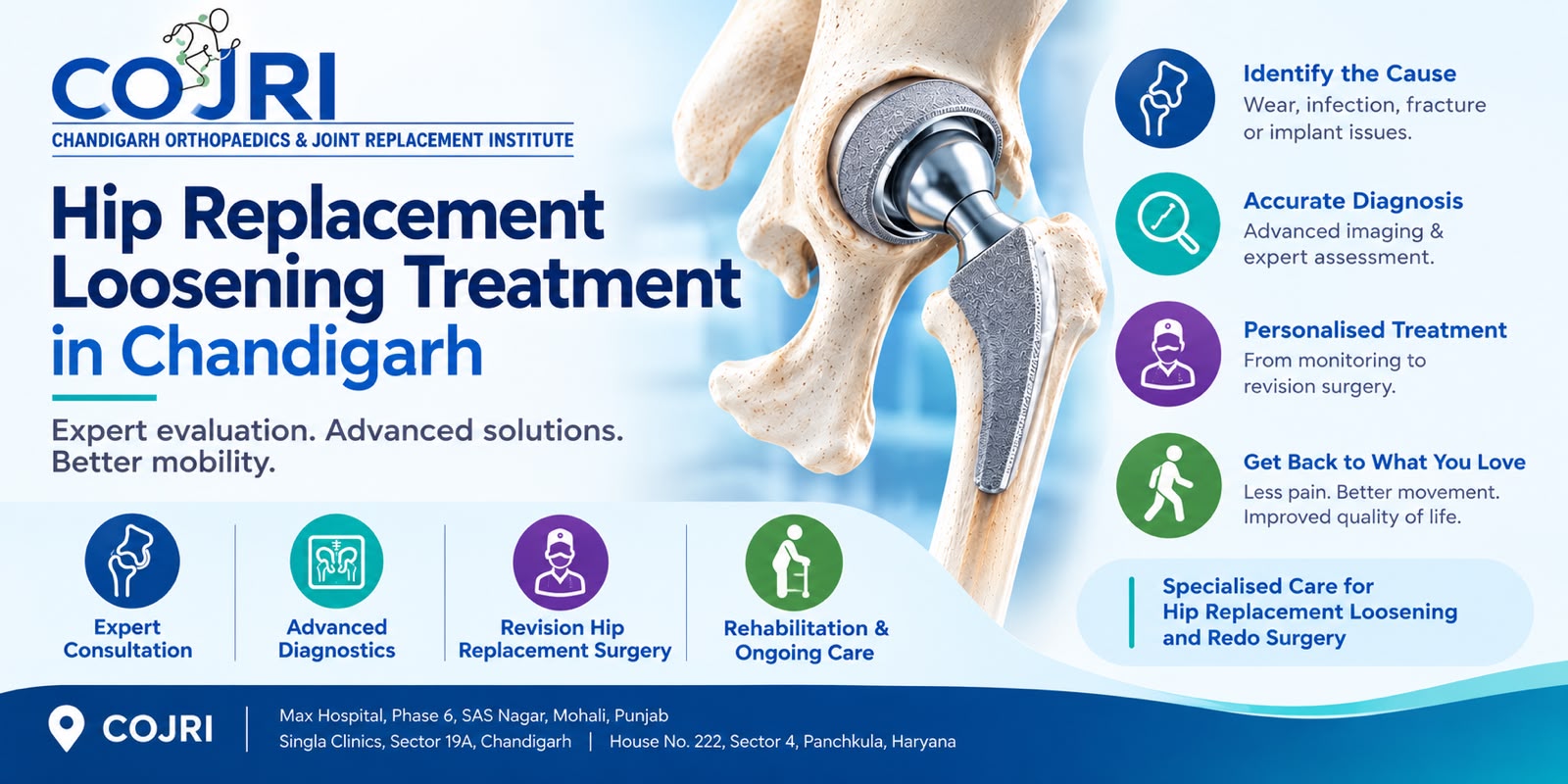
hip replacement loosening treatment Chandigarh
Understanding the reasons due to which an implant becomes loose, how the condition is diagnosed, and what the possible treatment options are is essential for patients seeking hip replacement loosening treatment Chandigarh. Based on the condition of the patient, treatment options may include doing nothing and monitoring the symptoms or performing a revision hip replacement surgery.
What Is Hip Replacement Loosening?
Hip replacement loosening occurs when there is a lack of secure fixation of an artificial hip joint component with the surrounding bone. A hip replacement may include a socket component and a femoral stem, which is placed in the thigh bone. Loosening may occur with either of the components.
In some cases, loosening is due to gradual wear of the implant and changes in the surrounding bone. In other cases, loosening may be due to an infection or other complications.
If a patient experiences persistent or new pain after hip replacement surgery, it may be due to a number of reasons and an orthopaedic assessment may be required to determine the reason rather than assuming the implant has become loose.
What Causes a Hip Replacement to Become Loose?
There may be a number of reasons due to which an artificial hip joint may become loose.
Wear of implant (gradual loosening) – Changes occur in the bone surrounding the implant and loosen the secure fixation of the implant.
Infection – It may cause loosening of the implant due to changes in the surrounding bone.
Dislocation (Fracture) – Loosening of the implant may occur if the femur breaks due to a minor injury or a fall.
Wear and Tear of Implant Components
Implants, like any mechanical device, can have components that deteriorate over time due to wear. One type of wear that can occur at a hip implant is that the surface of the bearing can break down to the extent that small particles are released. These particles can cause an inflammatory reaction that is gradually destructive to bone and can weaken the fixation of the implant. This is referred to as osteolysis.
Changes in the Surrounding Bone
Some loss of the surrounding bone can make it difficult for the components to remain securely attached. This can occur because of wear-related changes to the bone, or other bone conditions.
Infection Around the Hip Implant
An infection around a hip replacement can cause damage to the tissues around the joint, thereby weakening the fixation of the implant. Infections around a hip replacement can cause pain, swelling, and warmth around the joint and can even cause a fever and drainage from the wound. Not all infections, however, cause obvious symptoms.
Suspected infection requires prompt evaluation by a healthcare provider. The evaluation and treatment for infection is different from the treatment for aseptic loosening.
Fractures Around the Implant
Fractures of the thigh or pelvic bone can cause instability of a hip replacement, especially in the elderly if they fall or are injured.
Implant Positioning and Fixation Problems
Loosening of a hip replacement can occur because of positioning and fixation problems of the implant, as well as changes to the surrounding bone. The cause needs to be established to select the most appropriate treatment.
Knowing the symptoms of a loose hip replacement can help people know when to seek medical help. Some symptoms include:
Persistent or worsening pain in the hip, groin, thigh or buttock.
Pain when standing or walking, or pain when putting weight on the affected side.
Difficulty walking, change in walking style, or unusual gait.
Unstable feeling of the hip.
Hip giving way and not supporting the body.
Pain or problems with normal, day-to-day activities.
New pain or problem after previous improvement.
Not all of these symptoms mean the implant is loose. Other problems such as infection, tendon issues, fractures, and problems with the lower back may also cause these symptoms. Other tests may be required to find the actual problem.
Other symptoms which may indicate a problem include inability to bear weight on the operated hip, severe pain after a fall, and any symptoms of infection. These may require immediate medical attention.
To determine if the implant is loose, the surgeon needs to know if the implant is stable. An accurate diagnosis may allow a variety of treatment options.
To help the surgeon with diagnosis the patient may be required to:
Provide info about the first surgery and what happened since.
Explain where the pain is.
Provide records or other documentation about the first surgery.
Have X-rays or other tests done.
X-rays can give the surgeon an idea of the implant position and if there are any changes in the bone surrounding the implant. Other tests like a CT scan may be done if more details are required.
Blood tests may help identify signs of inflammation and infection. If a doctor suspects an infection related to an implant, he or she may suggest that the joint fluid be aspirated and sent for testing.
Tests are largely based upon the patients’ symptoms and clinical findings. It is important to find out if loosening is related to infection because it can change the treatment plan.
Hip Replacement Loosening Treatment in Chandigarh
The treatment is based on the extent of loosening and the health of the patient and surrounding bone.
If there is infection, but the symptoms are mild and the implant appears stable, the doctor may recommend doing nothing or some palliative care.
If there is significant pain or infection that leads to increased loosening of the implant and/or bone loss, then surgery may be required.
Revision surgery for infection-related loosening may involve removal of some or all of the infected implant components, along with the surrounding infected tissue.
Treatment may involve antibiotics and/or surgical procedures to clean the infected tissue, remove the infected components, and replace the implant components. The type of organism and the extent of infection will contribute to the surgeon’s decision for either a one- or two-stage procedure.
Long-standing cases may have deterioration of the surrounding bone. There may be loss of bone stock, and revision surgery may require use of special implants and bone reconstruction, in addition to other reconstructive measures, to support and stabilize the new implants.
Surgery is individualized to the patient’s needs and limitations.
Revision hip replacement surgery is more complex than the primary hip replacement because of the additional consideration for the original implant and associated complications.
The surgery typically consists of:
Assessment and removal of loose or damaged implant components.
Evaluation of surrounding bone and soft tissue.
Management of the infection and/or bone loss, if present.
Placement of new implants, if indicated.
Evaluation of joint stability.
Not all revisions require replacement of the entire implant.
Prior to surgery, patients should have a conversation with their surgeon regarding the potential benefits and risks of the surgery, expected recovery and rehabilitation, potential complications, and alternative courses of treatment.
Recovery varies according to the complexity of the procedure. Recovery time is also influenced by the patient’s general health and the quality of the patient’s bone. Presence of infection or significant bone loss also increases the time required for recovery.
Recovery from hip replacement revision surgery will typically require a personalized rehabilitation program, including:
Pain control: Following instructions for wound care and pain management.
Supported walking: Use of a walker or crutches as directed.
Physical therapy: Performing exercises to strengthen muscles and improve balance and mobility.
Movement precautions: Following any restrictions as recommended by the surgeon.
Follow-up care: Healing of the wound, stability of the prosthesis, and overall function.
Many patients begin early rehabilitation to improve mobility and, in some cases, can begin walking with assistance soon after surgery. Rehabilitation for weight bearing is typically prescribed and may vary depending on the type of reconstruction performed.
Risks and Possible Complications
Risks of revision hip replacement include persistent pain, loosening of the implant, blood clots, nerve injury, dislocation, and fracture.
There are additional challenges for a surgeon performing revision hip replacement because of significant bone loss and/or infection. A detailed preoperative assessment helps the surgical team develop a plan for those challenges and/or risks and explains the potential outcomes to the patient.
How to Select a Specialist for Revision Hip Replacement Surgery
When patients want to know more about treatment for loosening of the hip replacement in Chandigarh, they should consider the following.
The specialist should have the ability to evaluate a failing or a painful hip replacement.
Access to appropriate imaging and diagnostic studies.
Ability to assess loosening of implants and infection.
Experience with revision and complex reconstructive surgery of the lower limb.
Thorough discussion regarding treatment, risks and expected outcome.
Access to post-operative physiotherapy and care.
Patients searching for hip replacement redo Chandigarh may benefit from an assessment by an orthopaedic surgeon experienced in revision hip procedures.
Patients can visit COJRI to know more about the center, and to consult and take advantage of orthopaedic services offered by the center. Confirm availability of revision hip replacement services directly with the center when you call for an appointment.
Frequently Asked Questions
1. What are the first signs of a loose hip replacement?
Common warning signs include increasing hip, groin, or thigh pain, difficulty walking, and discomfort when putting weight on the leg. An examination and imaging are needed to confirm the cause.
2. Can a loose hip replacement be treated without surgery?
In selected cases, monitoring and symptom management may be appropriate if the implant remains stable or the symptoms have another cause. A mechanically loose implant that causes progressive symptoms or bone loss may require revision surgery.
3. What is hip replacement redo surgery?
Hip replacement redo surgery, also called revision hip replacement, is an operation to replace or repair one or more components of a previous hip implant.
4. When is revision hip replacement necessary?
Revision may be considered when implant loosening causes significant pain, progressive bone loss, instability, or impaired mobility. Infection and fractures around the implant may also require surgical treatment.
5. Is revision hip replacement more complicated than the first surgery?
It can be more complex because the surgeon may need to remove existing components, manage bone loss, treat infection, or reconstruct the joint. The complexity depends on the individual case.
6. How long does recovery take after hip replacement redo surgery?
Recovery varies according to the procedure and the patient’s health. Some patients progress over several weeks, while complex revisions may require months of rehabilitation. The treating surgeon will provide an individual recovery plan.
7. When should I seek medical attention for hip implant problems?
Seek an orthopaedic assessment for persistent or worsening pain, reduced mobility, or new instability. Fever, wound drainage, or increasing redness require prompt medical evaluation. Sudden severe pain or inability to bear weight after an injury requires urgent assessment.
Conclusion
If you think you have hip replacement loosening, it is best to see a doctor immediately. Depending on the results of the examination, you will know what to expect such as monitoring, treatment of underlying conditions, or revision surgery.
If you want to know more about hip replacement loosening treatment Chandigarh or revision hip replacement surgery in Chandigarh, contact a qualified orthopedic specialist for a thorough examination of your implant and advise what the best options are for you.
NAP: COJRI Contact Information
Name: Chandigarh Orthopaedics & Joint Replacement Institute (COJRI)
Primary Centre: Max Hospital, Phase 6, SAS Nagar, Mohali, Punjab
Chandigarh Clinic: Singla Clinics, House No. 3, Sector 19A, Chandigarh, 160019
Panchkula Clinic: House No. 222, Sector 4, Panchkula, Haryana 134112
Dr. Sandeep Gupta: +91 98159 33514
Dr. Jatinder Singla: +91 84272 70319
Connect With COJRI
LinkedIn: Dr. Sandeep Gupta on LinkedIn
Email: info@cojri.com
Appointments: +91 98159 33514 / +91 84272 70319
GMB: https://share.google/26IbbT8qszb0M1tUa