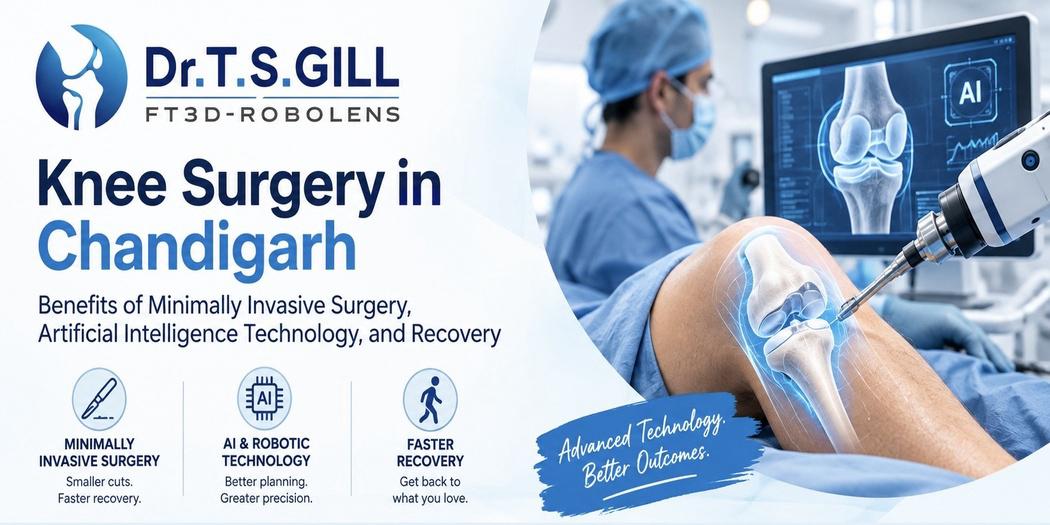
minimally invasive knee surgery Chandigarh
Knee pain can slowly impact your daily life. When the knee is injured by arthritis, a sports injury, or the breakdown of its internal structures, it may be difficult to walk, climb stairs, exercise, or rise from a chair. Medication and physiotherapy do help many people. However, there are some conditions that may require a surgical approach.
Advances in orthopedic surgery have resulted in techniques designed to minimize superfluous tissue trauma and improve surgical planning. If you are researching minimally invasive knee surgery Chandigarh, then it is important to understand which procedures may help your condition, how artificial intelligence (AI) and robotic technology are used, and what recovery involves.
Dr. Tarandeep Singh Gill | Orthopedic care for Knee and Joint Conditions in Mohali and Chandigarh Tricity | TSGill Ortho The right treatment depends on a correct diagnosis, your general health, and your personal goals for mobility.
What Is Minimally Invasive Knee Surgery?
Minimally invasive knee surgery refers to surgical techniques that use smaller incisions or aim to limit disruption to surrounding tissues compared with traditional approaches. The exact technique will depend on the condition being treated.
Two important examples are knee arthroscopy and selected knee replacement operations.
Arthroscopy of the Knee
Arthroscopy involves inserting a small camera, called an arthroscope, through a small cut in the knee to see inside the joint. Specialist instruments can then be used to tackle selected problems.
Arthroscopy may be appropriate for certain tears of the meniscus, certain ligament injuries or free fragments within the joint. But it’s not the treatment of choice for all knee problems. Widespread cartilage loss as the main problem in routine osteoarthritis pain has no meaningful benefit from arthroscopy.
Knee Replacement, Minimally Invasive
Knee replacement may be an option for people with advanced arthritis when pain and mobility problems continue despite appropriate non-surgical treatment. Certain surgical approaches use smaller incisions or techniques to preserve surrounding soft tissues.
The appropriateness of a particular approach depends on the extent of joint damage, anatomy, medical history, and surgeon’s judgment. Less incision does not equal better outcome for all patients.
When Should You Have Minimally Invasive Knee Surgery?
Surgery is usually considered after a diagnosis has been made and conservative treatments have been tried and found suitable.
1. Meniscus and Sports Injury
The meniscus is a cartilage structure that helps to distribute loads within the knee. Some tears may cause pain, swelling, catching or limitation in movement.
Depending upon where the tear is and what pattern it follows, treatment may include physiotherapy, changing the activities you do, repairing the meniscus or selectively removing damaged tissue. Some injuries may be appropriate for arthroscopy.
2. Ligament Injuries
Ligaments help to stabilize the knee when it moves. Instability due to injury to the anterior cruciate ligament (ACL) or other ligaments is common, particularly with pivoting activities.
Some injuries you can recover from with rehab, some may require reconstruction. Decision depends upon instability, associated damage, goals of activity, and response to non-surgical treatment.
3. Advanced osteoarthritis of the knee
Osteoarthritis is a progressive disease that results in joint changes, including damage to cartilage. Symptoms include pain with movement, stiffness, swelling and difficulty walking.
Knee replacement may be discussed if symptoms significantly affect daily activities, despite appropriate non-surgical care. Arthroscopy is usually not a fix for advanced osteoarthritis.
How Does AI Knee Surgery Work?
AI knee surgery Chandigarh is a term that is often used by patients while researching technology-assisted orthopedic procedures. It is important to distinguish AI-assisted planning, computer navigation, robotic assistance and arthroscopy as these technologies are employed for different purposes.
Artificial intelligence can support planning, recognize patterns or process medical images in some medical applications. Depending on the technology used, computer-assisted and robotic systems can help the surgeon evaluate alignment, plan bone preparation, or guide components of a knee replacement procedure.
These systems do not decide for themselves if a patient needs surgery. The surgeon retains responsibility for interpreting the clinical findings, selecting the procedure and making surgical decisions.
Possible advantages of technology-assisted surgery
Technology-assisted planning can help with: * depending on the system and process
Individualized planning: Assisting with assessment of the patient’s anatomy and joint alignment.
Surgical guidance – Giving measurements or feedback during some procedures.
Planning consistency: Assisting the surgeon in evaluating the position of the implant and other technical parameters.
Facilitating Informed Discussions: Helping patients to understand the intended procedure by explaining it visually.
Technology does not eliminate surgical risk or guaranty less pain, quicker recovery or longer lasting implants. The outcome depends on the diagnosis, the judgment of the surgeon, the procedure and rehabilitation.
Patients should inquire about the particular system being used, its relevance to their condition, and whether it provides a meaningful advantage over the available alternatives.
Advantages and Disadvantages of Minimally Invasive Approaches
Minimally invasive approaches can confer practical advantages when properly chosen.
Smaller Incisions and Preservation of Tissue
Some procedures may require smaller incisions and less disruption of surrounding soft tissues. The amount of preserved tissue varies with the procedure and individual anatomy.
Postoperative Relief
May contribute to postoperative comfort, in selected procedures, by less tissue disruption. But pain is variable and minimally invasive surgery is not pain-free surgery.
Rehabilitation and mobility
Some patients may start supervised movement soon after surgery. The plan for rehabilitation is determined by the type of surgery, healing requirements and any related procedures.
Important Restrictions
Minimally invasive techniques are not indicated for all conditions. A different surgical approach may be needed in patients with complex injuries, severe joint destruction, or unusual anatomy. In some cases, the surgeon may need to change the planned procedure to be safe.
The goal should be the best treatment for the patient, not the selection of an operation simply because it is described as minimally invasive or technology-assisted.
What does recovery after knee surgery look like?
Recovery depends on whether the patient has arthroscopy, ligament reconstruction or knee replacement. Your surgeon and physiotherapist will advise you according to the procedure and your progress.
Early Recovery –
In the first few days, care may focus on managing pain, controlling swelling, caring for the wound and ensuring safe movement. Depending on the procedure, crutches or a walking aid may be required.
Follow instructions about weight bearing, bending your knee, medications, and wound care. Not all minimally invasive procedures let patients walk around unrestricted right away.
Physiotherapy & Strengthening
Rehabilitation helps to restore movement, muscle strength, balance and confidence. The exercises are introduced progressively and modified according to the healing process and clinical assessment.
Some procedures allow for a relatively short recovery after arthroscopy, while ligament reconstruction and knee replacement typically require more extensive rehabilitation.
Back to Normal Life
The time for return to work, driving, exercise or sports depends on the procedure and individual recovery. Jobs that involve standing for long periods or physical labor may require more recovery time than desk-based work.
Follow-up appointments allow the care team to monitor progress and manage complications. If you develop troubling symptoms (fever, wound drainage, increasing redness, severe calf pain, or progressive swelling), seek medical attention promptly. Chest pain or sudden breathlessness should be urgently assessed.
How to select an orthopedic surgeon in Chandigarh?
Before surgery, have your orthopedic surgeon explain your diagnosis, the treatment options, and what the recovery will be like.
Helpful questions are:
Can physiotherapy or other non-surgical treatment help my condition?
What is the recommended procedure and why?
Is arthroscopy, knee replacement or some other method appropriate in my case?
How much of my operation will be done with AI-assisted or robotic technology?
What are the risks and alternatives?
What rehab will I need and when can I get back to normal activities?
According to his official website, Dr. Tarandeep Singh Gill is an MS in Orthopedics and MCh in Orthopedics, and has done his fellowship training in arthroplasty and arthroscopy in Germany. His practice includes limited sports injuries, robotic-assisted surgery and joint replacement.
The individual consultation can help determine if surgery is necessary and which approach is best suited to your needs.
Frequently asked questions (FAQs)
1. What is minimally invasive knee surgery?
It refers to surgical approaches that employ smaller incisions or reduce disruption to surrounding tissues. Examples include arthroscopy for selected knee conditions and selected techniques for knee replacement.
2. Is AI and robotic knee surgery better than traditional knee surgery?
Not necessarily for all patients. AI-assisted planning and robotic systems can help with certain parts of surgery, but how useful they are will depend on the condition, the technology used and the clinical circumstances. No system guaranties a better outcome.
3. Is arthroscopy equal to robotic knee replacement?
No. An arthroscopy uses a very small camera and instruments inside the joint. Knee replacement assisted by robots uses specialized technology to help plan or guide parts of the joint replacement surgery. They solve different problems.
4. How long is recovery from minimally invasive knee surgery.
Recovery time after certain arthroscopic procedures may take days to several weeks. Ligament reconstruction and knee replacement may take several months. The actual time frame depends on how the operation and rehabilitation progress.
5. Is minimally invasive surgery appropriate for older patients?
You’re not just suitable by virtue of age. The risks and benefits of treatment, overall health, condition of joints, mobility and other medical problems need to be assessed.
6. Is arthroscopy used to treat arthritis in the knee?
Arthroscopy is not generally recommended for routine knee osteoarthritis alone. If you have advanced arthritis and your symptoms persist, you may require other treatment options. Your doctor may assess your need for a knee replacement.
Doctor: Dr. T. S. Gill
Address: MAX SUPER SPECIALITY HOSPITAL
3RD FLOOR, NEW BLOCK B
PHASE 6, (SECTOR 56)
MOHALI, CHANDIGARH TRICITY
PUNJAB, INDIA
Phone: +91-82880 15106
+91- 62395 89197
Google bussiness Profile: https://share.google/Nn5oiuycUi0s4WVTD
Website: https://tsgillortho.com/
Instagram : https://www.instagram.com/drtarandeepsingh
Linkedin: https://www.linkedin.com/in/dr-tarandeep-singh-gill-b88746429/