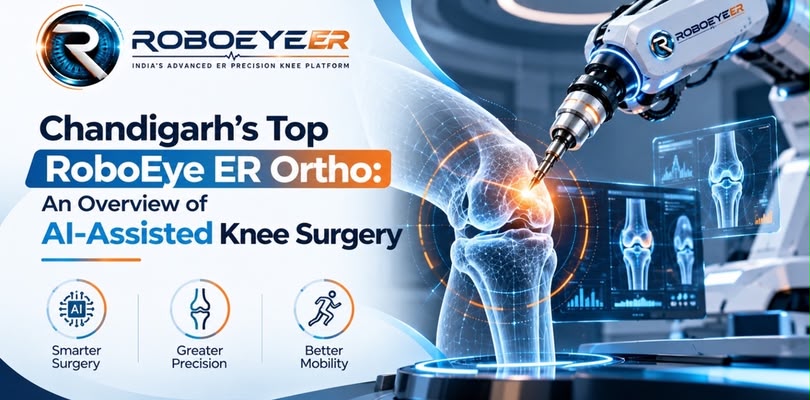
Best RoboEye ER Ortho in Chandigarh.
Knowing this technology might help you be ready for an informed conversation with an orthopedic doctor if you’re looking for the Best RoboEye ER Ortho in Chandigarh. Extended-reality visualization and joint replacement surgical planning are related to ROBOEYE ER. Instead of taking the place of expert medical judgment, such technology is intended to enhance the surgeon’s comprehension of each patient’s unique anatomy.
Before choosing surgery, patients considering AI Knee Surgery Chandigarh choices should be aware of how these systems operate, who might benefit from them, and why a customized medical evaluation is still necessary.
ROBOEYE ER Technology: What Is It?
In robotic-assisted joint replacement, ROBOEYE ER is linked to extended-reality (ER) visualization. Technologies that help clinicians visualize pertinent anatomical features and surgical information by fusing digital information with a view of the actual environment are collectively referred to as “extended reality.”
Planning for a knee replacement typically entails assessing the patient’s knee anatomy, joint alignment, bone health, and degree of cartilage degeneration. Digital visualization may assist the surgeon in reviewing anatomical data and planning certain elements of implant placement, depending on the technology and surgical workflow.
The technology, how it is configured, and the therapeutic process being carried out all affect the precise capabilities that are available during an operation.
It is crucial to realize that the phrases artificial intelligence and robotic aid are not synonymous. While AI relates to particular computing techniques, a robotic system might help with planning or performing surgery. It is advisable for patients to inquire with their physician about the capabilities utilized in the prospective surgery.
Comprehending Chandigarh AI Knee Surgery
In contemporary orthopedics, discussions about robotic and AI Knee Surgery Chandigarh are growing. These methods help certain aspects of surgical planning and treatment with digital tools.
In a traditional knee replacement, the surgeon removes damaged joint surfaces and places prosthetic parts in the best feasible positions to restore function. Digital planning, anatomical mapping, or technology-guided support may be added to specific stages of the procedure using robotic-assisted techniques.
How Does Knee Replacement with Robotic Assistance Operate?
The following steps may be involved in the process, albeit procedures differ between systems:
1. First consultation and evaluation
Your symptoms, medical history, physical examination results, and imaging data are all reviewed by the orthopedic specialist. The goal is to find appropriate therapy choices and ascertain the reason of your knee pain.
2. Digital planning for surgery
The surgeon can design implant positioning or alignment and evaluate the anatomy of the knee with the aid of digital information when the system supports it. The technology being used determines the exact planning technique.
3. A surgical technique aided by technology
The intended technique is carried out during surgery by the surgeon using clinical judgment and the available guidance system. The technology does not make all treatment decisions on its own; it only helps with some jobs.
4. Rehabilitation following surgery
Movement, pain management, wound care, and physiotherapy instructions are given by the care team following surgery. Rebuilding strength and increasing mobility require rehabilitation.
Possible Advantages of ER-Assisted Knee Replacement with ROBOEYE
When looking into advanced knee replacement choices, patients frequently want to know if the new technique has any significant benefits. The system, the surgeon’s experience, the patient’s condition, and the treatment plan as a whole all affect potential advantages.
1. A more thorough visual representation
Surgeons may be able to visualize anatomical information during planning or specific stages of a procedure with the aid of extended reality equipment. Surgical decision-making may be aided by this extra visual data.
2. Customized Surgical Scheduling
Each knee has unique anatomical features. The surgeon may be able to customize implant orientation and alignment to the patient’s unique anatomy with the aid of technology-assisted planning.
3. Assistance with Surgical Accuracy
Depending on how they are built, robotically assisted systems can offer direction or feedback while performing particular surgical procedures. Although the real benefits differ between systems and people, the goal is to assist the surgeon in carefully carrying out the plan.
4. A Methodical Approach to Therapy
Prior to surgery, digital planning might assist in organizing crucial information. This could facilitate communication about the procedure, anticipated recovery, and necessary rehabilitation between the surgical team and the patient.
5. An Emphasis on Functional Recovery
Reducing pain and enhancing everyday function are the ultimate goals of knee replacement. Technology is just one aspect of the treatment process; other crucial components include pain management, rehabilitation, surgical skill, and suitable patient selection.
Important: No robotic or AI-assisted system will ensure a quicker recovery, a pain-free knee, or a procedure devoid of complications. Inquire with your surgeon about the supporting data for the particular technology being provided.
Who Could Benefit from Robotic-Assisted Knee Replacement?
For certain patients with severe joint degeneration, robotic-assisted knee replacement may be an option. However, rather than relying solely on the availability of cutting-edge technology, the choice to operate should be based on clinical need.
When a patient encounters any of the following, a specialist may consider knee replacement:
persistent knee pain that makes it difficult to walk or do daily tasks.
significant cartilage loss or advanced osteoarthritis.
knee stiffness that prevents you from moving normally.
joint ache that makes it difficult to sleep or carry out daily duties.
limited improvement with suitable nonsurgical interventions.
Physiotherapy, activity adjustment, medication, weight control where necessary, and other clinician-recommended treatments may be the first steps in treatment.
Surgery is not necessary for everyone who has knee pain. The diagnosis, the state of the bones and joints, general health, and the surgeon’s evaluation all influence whether a robotic-assisted treatment is appropriate.
How to Pick the Best Orthopedic Expert
Look past the name of the technology when looking for the best Roboeye ER ortho in Chandigarh and the neighboring Tricity region. Important factors to take into account include the surgeon’s training, joint replacement expertise, communication style, and postoperative assistance.
Think about the following before selecting a therapy provider:
Relevant expertise: Find out about the surgeon’s orthopedic training and knee replacement procedure experience.
Details about technology: Verify the type of robotic or extended-reality system being used and its actual functions during surgery.
Treatment options: Recognize whether traditional surgery or nonsurgical therapy could be more suitable.
Limitations and hazards: Talk about stiffness, blood clots, implant-related issues, infection, and other health-related problems.
Support for rehabilitation: Inquire about physical therapy, follow-up appointments, and the anticipated phases of recuperation.
Transparent costs: Ask for a written estimate that details the costs of hospital stays, implants, tests, and rehabilitation.
After a thorough consultation, you should have a comprehensive grasp of your diagnosis, your alternatives, and the rationale behind the suggested course of action.
Recuperation Following Robotic-Assisted Knee Replacement
Everybody recovers differently. Rehabilitation may be impacted by age, general health, muscular strength, the severity of joint dysfunction, and the difficulty of the surgery.
Following a knee replacement, patients typically start moving under supervision as directed by the medical staff. Physiotherapy helps strengthen surrounding muscles, increase knee mobility, and progressively regain confidence in daily activities.
Observe your surgeon’s recommendations regarding wound care, walking assistance, medicines, exercises, and follow-up appointments while you’re recovering. Individual healing timelines vary, so avoid comparing your progress too closely to that of another patient.
If you have any worrisome symptoms, such as worsening pain, fever, sudden calf swelling, or rising wound redness, get in touch with your medical team right away. Emergency medical care is necessary if you have sudden dyspnea or chest pain.
FAQ
1. In knee replacement surgery, what is ROBOEYE ER?
Extended-reality visualization and joint replacement surgical planning are related to ROBOEYE ER. The system and clinical process that the surgeon uses determine its particular functions.
2. Does Chandigarh offer AI knee surgery?
The Chandigarh–Mohali area offers robotically assisted joint replacement treatments. To find out if ROBOEYE ER is accessible for their procedure and which specialist does it, patients should get in touch with the appropriate hospital.
3. Is knee replacement with robotic assistance superior to traditional surgery?
Not always, though. In some circumstances, robotic help may provide planning or guidance benefits, although results rely on a number of variables. The evidence and limits pertinent to your case can be explained by your surgeon.
4. Does ROBOEYE ER reduce the danger of surgery?
No, there are dangers associated with every surgical surgery, such as infection, bleeding, blood clots, stiffness, and issues with the implant or anesthesia. These hazards are not eliminated by technology.
5. How long does it take to recover from a knee replacement?
Everybody recovers differently. While strength, mobility, and confidence can continue to improve over several months, many patients achieve slow progress over a few weeks. Your clinical progress should serve as the foundation for your rehabilitation plan.
6. If my knee pain persists, who should I see?
If your knee discomfort continues, restricts your range of motion, or does not get better with the right care, see a licensed orthopedic specialist. Seek immediate medical attention if you are unable to bear weight, have a heated, swollen joint with a fever, or are experiencing excruciating pain following an injury.
7. How do I schedule a robotic knee replacement consultation?
Make contact with the orthopedic division of the hospital where the surgeon of your choice works. Inquire about the availability of consultations, the appropriateness of robotic-assisted surgery, the necessary tests, and the anticipated cost of treatment.
NAP Information and Contact Details
Doctor: Dr. Bhanu Pratap Singh Saluja
Speciality: Orthopaedics, Joint Replacement and Sports Medicine
Hospital: Park Grecian Super Speciality Hospital
Address: Jail Road, Phase 9, Sector 69, Sahibzada Ajit Singh Nagar, Mohali, Punjab 160062, India
Contact number: +91 83310 00038
SOCIAL MEDIA
Facebook:https://www.facebook.com/Dr.BhanuPratapSinghSaluja
Instagram:https://www.instagram.com/bhanupratapsinghsaluja?stkn=MXJ1cDBicW8xeHJwMQ
Youtube : https://www.youtube.com/@Dr.BhanuPratapSinghSaluja/videos